Phone appears as Preview in the public product catalogue, menus, homepage product list, Phone page and tour. Hullo is its approved character. Public samples are fictional; live setup comes later and provider acceptance is required before real calls. Enabling Phone in business settings exposes the preview workspace without connecting a live line or purchasing a number.
Preview implementation; not live provider acceptance. Phone is enabled independently for a business. It owns receptionists, numbers, call routing, call history and callbacks. Inbox, CRM and Bookings remain optional; enabling Phone does not enable another product or grant its permissions. The pilot direction is overflow and closed-hours reception while staff remain first destination when staffed. Retaining an existing BT number requires separately verified forwarding configuration and costs.
Workspace and setup
Open Phone in the business workspace. Overview shows service readiness, recent call outcomes and callback work. Calls holds source summaries, separately permissioned transcripts and recording playback. Callbacks holds assignment, due time and a manually recorded outcome. Receptionists separates saved drafts, fixed simulation and published versions. Numbers, Routing, Usage & billing and Settings expose their own permissioned controls. A saved configuration is not provider readiness.
Publish only information approved for callers. Internal Messages knowledge does not automatically enter this receptionist. Each admitted call pins a published version, while live source eligibility and permissions are checked again for its tools. Simulation rehearses fixed routing text without making calls, checking live availability, reserving stock or sending messages. It is not an AI voice test.
Provider binding, number provisioning and commercial rates currently require reviewed operator setup; number purchase/release is not yet a customer self-service screen. A number requires routing and real inbound evidence before activation. Pausing/suspending service and relinquishing a number are separate. An explicitly approved business spending cap is required; configuration does not silently approve an illustrative price.
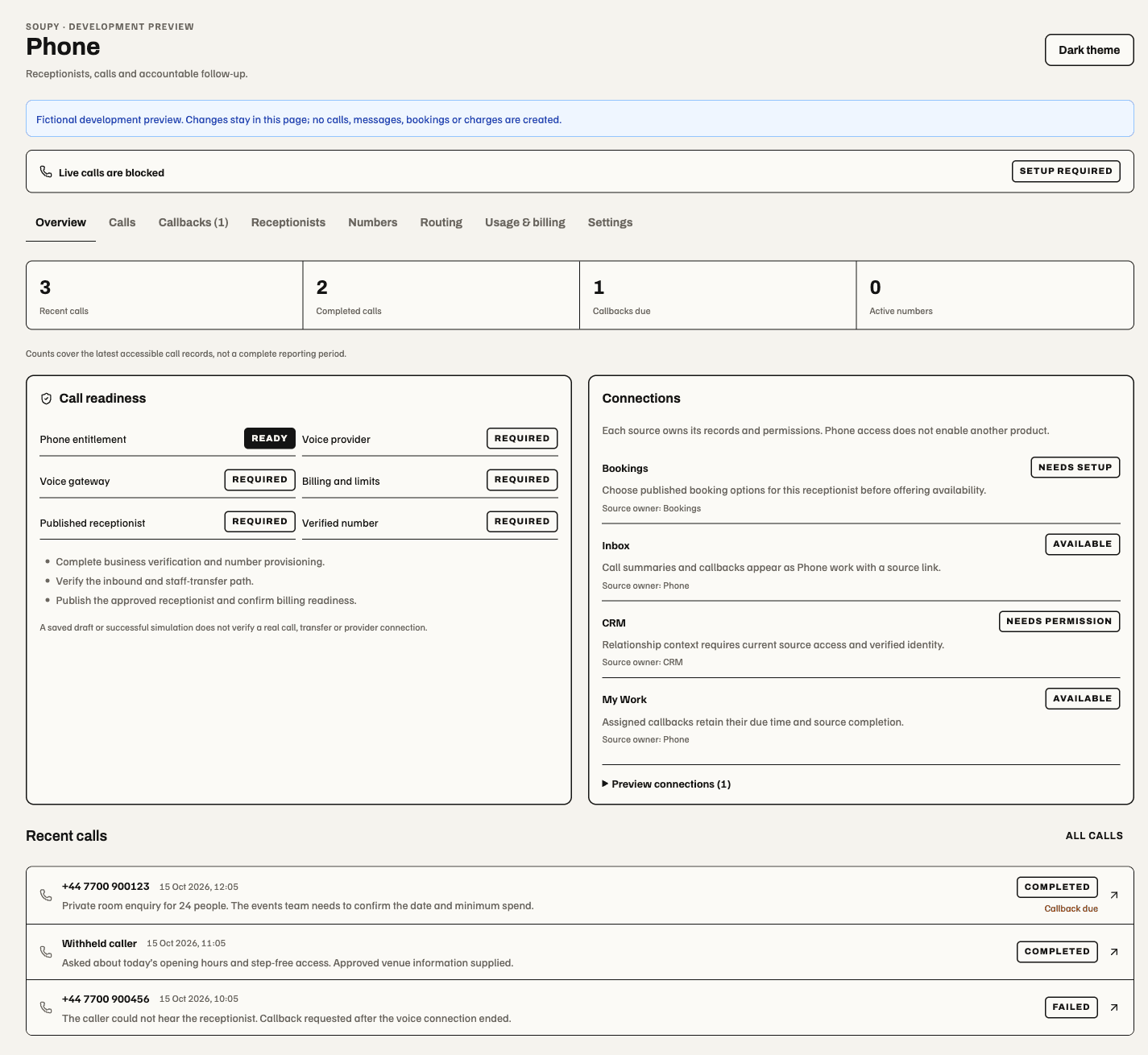
Local component fixture, 15 October 2026; fictional data, not a connected business. Readiness identifies provider/activation blockers. Callbacks opens Phone-owned obligations. The bounded recent-call display is not an unlimited historical analytics report. The same components were inspected at desktop and narrow widths in both themes.
Callers, transfers and callbacks
The provider identifies the correct business and approved Site from the provisioned number; caller speech cannot select another business or arbitrary telephone destination. The caller receives an AI/recording notice and a route to decline recording. Approved transfers ring one configured destination for 20 seconds and require the recipient to press 1 before bridging. Acceptance and actual bridge success are different evidence. Busy, no answer, rejection, voicemail pickup or failed bridging goes to the callback fallback.
Phone owns callback assignment and completion. Inbox has a genuine Calls source, and its Unified view can show callback work beside email and Forms. Calls do not acquire email reply/unread state. A verified booking continuation can record a CRM call attribution without matching caller ID or overwriting a customer profile; CRM reveals that entry only with current Phone source access. My Work projects the same Phone obligation with a generic title; it carries no transcript or caller identity and cannot reassign or complete the Phone source. Opening the OS dialler is not a contact outcome. Record what happened before marking a callback complete.
Connected information and bookings
Published Ticketing events for the approved Site can provide current public information, ticket availability and the exact purchase page. The purchase page owns final eligibility and sales. Private holders, refunds, staff schedules and unpublished information are outside the caller tool set.
With an approved published Bookings widget, the receptionist can search and quote source availability, then send a private continuation by SMS or email. The guest verifies their chosen contact and accepts the exact details and terms on that page before the canonical reservation begins. Verification codes and card fields stay outside the call/model context. Caller ID and contact control do not reveal earlier bookings or automatically merge customer records.
Bookings keeps its payment policy and reservation expiry. No payment due now does not make the booking free. Deposits/full payments use the canonical seller checkout; eligible card-guarantee bookings securely save a payment method with no immediate charge. An interrupted call can continue from its original link. The page distinguishes confirmation, outstanding verification/payment/card setup, expiry and unavailable outcomes. Late card setup cannot recreate expired capacity. Uncertain provider results recover the existing operation.
Unsupported operational requests can be recorded for staff callback; the pilot does not authorize speech-driven refunds, booking amendments, stock movements, purchasing approval or unrestricted internal knowledge. Rotas routing, Sport screenings, Displays aggregates and specialist write adapters remain later connections. Wi-Fi character Roam does not establish a shipped Wi-Fi module.
Privacy, billing and devices
Audio/transcript access expires after 30 days. Provider media deletion retries failures; providers may retain separate metadata. Summaries default to 90 days; the configurable 7–365 day policy applies to newly admitted calls. Booking acceptance, security terms and financial evidence retain their source policies. Recordings stop before the staff leg; playback requires current source scope and a short-lived grant. Privacy administrators can export retained call content or erase it with a recorded reason. Erasure denies further content access at once and queues active-call stopping and provider media deletion; a pending provider deletion remains visible. Source booking and financial evidence is not erased by a Phone content request.
Guest-to-venue payments are separate from business-to-Soupy Phone charges. Phone has a platform usage/rating ledger and draft invoice workflow; it does not use restaurant/event Orders for subscription charges. Monthly snapshots include zero-call base fees, and late usage creates an idempotent adjustment. Invoices remain drafts; automatic collection, dunning and commercial self-service are not enabled. Provider cost revisions stay separate from immutable customer rates. Twilio call/SMS prices are reconciled against known provider identities; AI, email, number rental and storage still need reviewed invoice-cost evidence. Unpriced sources and separate currencies remain explicit. Approved rates, provider acceptance and paid activation are separate release conditions.
Web supports configuration and operations. Desktop hosts that workspace and retains its draft lifecycle; installed microphone and live-call acceptance are still required. Native initially supports source summaries and callbacks, uses the device dialler and hands configuration/playback to web. Native source/tests do not prove installed-device or store acceptance.